

Unionism: A Hearts and Minds Conversation
The debate about Northern Ireland’s future is often framed through two long-standing traditions: unionism and nationalism. While frequently discussed as political positions, they are also identities shaped by history, culture and belonging.
Ironically, both traditions share the same underlying concept — union. One seeks union with the United Kingdom, while the other seeks union across the island of Ireland in a single state.
Yet the future of Northern Ireland may depend less on legacy labels and more on what matters to people today: economic stability, making ends meet, providing for oneself, family and community, opportunity, identity, and societal progress. In other words, the debate increasingly comes down to hearts and minds.
UNIONISM IN MODERN TERMS
In contemporary terms, unionism is the belief that Northern Ireland should remain part of the United Kingdom, maintaining its constitutional, economic and cultural relationship with Great Britain.
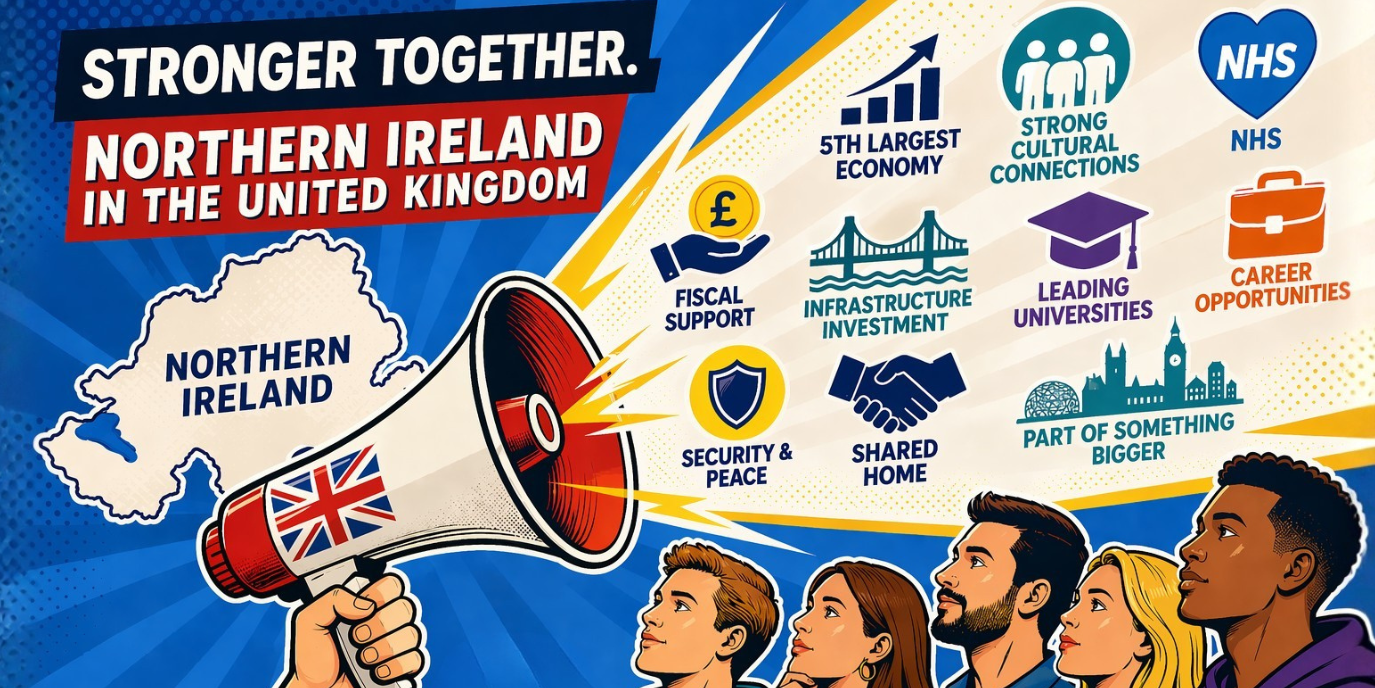
For many unionists, this connection represents stability, shared institutions and opportunity — from access to the National Health Service to participation in one of the world’s largest economies.
Nationalism, by contrast, supports the idea of a single united Ireland comprising Northern Ireland and the Republic of Ireland. Within that tradition, republicanism historically represents a more assertive strand advocating Irish unity, while nationalism broadly pursues that aspiration through democratic politics.
Today these positions are debated peacefully through democratic institutions under the framework of the Good Friday Agreement, which established that Northern Ireland’s constitutional status can only change with the consent of a majority of its people.
A CHANGING SOCIETY
Northern Ireland today is more complex than the traditional political divide suggests.
Research from the Northern Ireland Life and Times Survey shows that around 40–50% of people now identify as neither unionist nor nationalist. This growing middle ground is less concerned with historical labels and more focused on practical issues such as economic opportunity, stability and quality of life.
At the same time, polling from organisations such as LucidTalk consistently shows that a majority of voters still favour remaining within the United Kingdom, although the margins fluctuate depending on the political climate.
This reality matters. The constitutional debate will increasingly be decided not by traditional loyalties, but by those who sit outside them.
THE MESSAGING CHALLENGE
And this is where unionism faces a challenge.
Nationalist parties have become highly effective at shaping the public conversation. They are disciplined, consistent and often louder in their messaging. As a result, their narrative can dominate the public space.
Unionist parties, while increasingly vocal, are often fragmented in both message and presentation. Multiple voices speaking independently can dilute the strength of the overall argument.
In any debate, a single clear message will always travel further than many competing ones.
Unionism therefore does not need to change its core belief. But it does need to sharpen how it communicates it — clearer, stronger and more unified.
A STRONGER UNIONIST VOICE
The reality is that clearly unionism has a strong case to make.
Northern Ireland benefits from economic integration with the United Kingdom, shared institutions, fiscal support and centuries of social and cultural connection across England, Scotland, Wales and Northern Ireland.
These are not abstract ideas. They are everyday realities that provide stability and opportunity for people and businesses.
But in a modern media environment, facts alone are not enough. The message must be delivered clearly, confidently and consistently.
Unionist parties are becoming louder, but the next step is to become more strategically aligned, more polished and more disciplined in how the message is presented.
Nationalist parties have long understood the importance of narrative. Unionism must now do the same. I am sure Nationalists would say that copying is the sincerest form of flattery. However, Unionists shouldn’t just copy, they should raise the bar and set a new and better standard for the narrative.
WINNING THE HEARTS AND MINDS CONVERSATION
Ultimately, the future of Northern Ireland will not be decided by who shouts the loudest.
It will be decided by the hearts and minds of the people, particularly those who do not strongly identify with either tradition.
For unionism, the task is clear: present a confident and inclusive vision for the future — one built on stability, economic opportunity and shared prosperity.
Because the strength of unionism lies not just in history, but in the practical benefits people experience every day as part of the United Kingdom.
And perhaps the message should be simple.
If the argument is about building the strongest future for Northern Ireland — economically, socially and culturally — then unionism has the most compelling case, especially as a sovereign and independent economy not reliant on Europe.
With a strengthen Unionist voice the future of Northern Ireland has to be about moving beyond the current status quo and legacy arguments. It has to be in the context of its continued place in the United Kingdom but also in the context of its place on the island of Ireland, finally and truly taking advantage of its placement geographically and culturally. We have, on all sides, talked the talk enough, and now is time to walk the walk together and move to a greater thriving and not just surviving Northern Ireland despite itself.
In the end, the future of Northern Ireland will not be decided by slogans or noise.
It will be decided by which vision offers the most stable, secure and prosperous future for the generations to come, and what I hope will be based truly on hearts & minds, and those that are united together as a continued part of the United Kingdom.
Claire Scull is a former parliamentary candidate for Northern Ireland Conservatives