

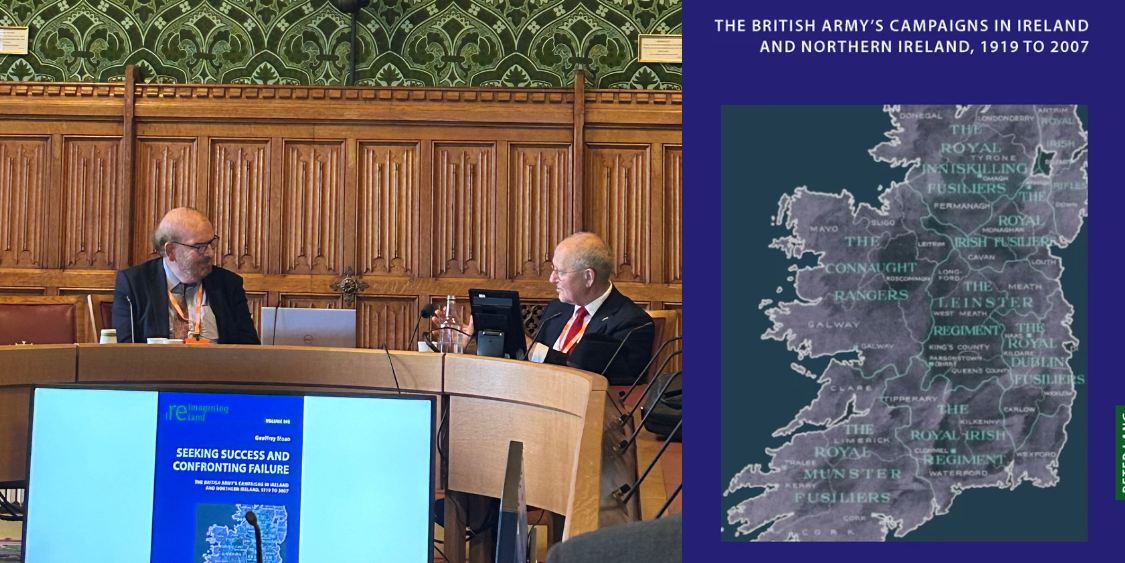
Seeking Success and Confronting Failure: The British Army’s Counter-Insurgency Campaigns in Ireland and Northern Ireland, 1919–2007
by Geoff Sloan
Peter Lang Publisher Launched 12th November 2025
A review by Professor Gwythian Prins
This is a book of capital importance. Professor Sloan is a seasoned traditional historian (which is a compliment); and this work is evidently the fruit of many years of mining a mixture of hitherto insufficiently exploited public records as well as, for the modern period, oral sources hitherto not used. Methodologically, it is a well-grounded work of empirical history in which theory is a handmaiden and not a dominatrix. It is genuinely trail-blazing. In the extensive literature on modern Ireland, Sloan has provided new and in many ways astonishing insights by the brave and simple decision to compare and contrast the British handling of the 1919-21 Sinn Fein guerrilla war against British rule with the PIRA campaign 1969-2007 that effectively ended with the “Belfast Agreement” 1997, a functional defeat imposed on the Army by the Blair administration in the first flush of its accession to power. In both cases the British experienced defeat with consequences outside Ireland: in decolonisation at large and in ‘devolution’ within the Union.
What this book dissects, and displays is how those defeats were inflicted. Neither was as a result of military success by IV/SF/IRA/PIRA. Sloan shows how, in both campaigns, the two Irish Constabularies (Dublin & Royal Irish)/Royal Ulster Constabulary/British Army and Intelligence Services were operationally successful but cut off at the knees and denied victory by other parts of the British state. In each campaign he points to one man pre-eminently responsible; and they are named, compared and contrasted. Prime Minister Lloyd-George’s mordant view of the first of them, Alfred Cope, was: “For dirty work give me the dirty man.” Sloan shows how it applies as well to the second, Jonathan Powell.
Anglo-Irish history is criss-crossed with metaphorical barbed wire and planted with metaphorical landmines. Sloan expertly navigates this terrain. It will make – even today – uncomfortable reading on the lengthening bookshelf of Whitehall’s undermining of British sovereign interests, which it book-ends, from the end of empire to the present: 1919/21 was an important initial trend-setter and in 1997/98 Blair’s surrender of Hong Kong – and the Belfast Agreement – were a sort of coda – but in fact pause only until Starmer/Hermer/Sands/Powell (again) arrived to continue serial surrendering. The book will also make uncomfortable reading in Dublin. The foundation myth of the Irish Republic is just that: myth. There was no victory of Irish arms against the Crown. What it documents about IV/SF/IRA/ conduct during 1919/21 and PIRA/Irish Republic from 1968 to 2007 will jolt the received nationalist narrative of Irish struggle by Irish agency which, as is usual, was written by the victors’ pen. Sloan’s work provides a hitherto missing counter-balancing view. His review of the 2006 Banner Report is particularly excoriating: no substantive lessons had been learned.
In sum: the book is genuinely original in conception and framing; methodologically sound in execution; appropriately sourced; clearly written in uncluttered prose; and thereby it contributes a new and uncomfortable dimension to our understanding of Anglo-Irish history across the twentieth century.
MAJOR ARGUMENTS OF THE BOOK
Sloan employs a theory of ‘operational codes’ of conduct to interpret the two campaigns. He takes this key from Basil Liddell-Hart who – an Army man – was no different in his geostrategic appreciation from Sir Halford Mackinder or Sir Julian Corbett before him in the last decade before the Great War. All held that Britain’s prime policy instruments were economic pressure applied thought unchallengeable sea-power: “He [B L-H] denounced the ‘unbusinesslike allurements of the Continental theory ’”, writes Sloan. “He claimed these ‘operational codes’ lay hidden: ‘A romantic habit had led us to hide, and has even hidden from us our essentially business-like tradition in the conduct of war.’ This tradition assumed reciprocity, and a transactional process that would be accepted by an enemy, whether it was a state or an extreme political organisation committed to the use of violence. [Emphasis added] Its key characteristic was a synthesis of mutually beneficial exchanges and interactions that would elicit a pathway to a desired political outcome satisfying both parties… a feeble conceit which assumed by negotiating with the IRA they would become ‘more like us’. The British policy elite were unable to square the violence and ideology of Irish Republicanism with the image of themselves conducting a business transaction. [Emphasis added]” In short, the end point of war should be a negotiation, not defeat of the enemy. The same choice currently vexes debates over Israeli war objectives against its unconditional enemies Hamas, Iran and its other proxies. There are no negotiations to be had with those whose intent against you is genocidal (‘kill the Jews’). Sloan argues that “…The failure to examine these operational codes, with one or two exceptions in the vast literature both campaigns have generated, have made it difficult until now to fully evaluate the challenges the Army and the three police forces had to face.”
Sloan’s critique rotates around the status of and range of the possessive adjective ‘our’ as applied to the soi-disant business-like tradition: for the nub of his case is that it only applied to what other historians of this era have called the ‘Official Mind’ that inhabited Whitehall and most especially Great Charles St (the Foreign Office). Most especially this culture, its values and application ran counter to those common to the Police Services, Security Services and Army of both campaigns.
While not a completely clean cursor – how could it be? – the book shows how in practice, “…this often resulted in political choices operating independently from tactical actions by the army and thus compromising the outcomes the latter was trying to achieve.” Civil servants in Dublin Castle or in Blair’s kitchen cabinet chose not to pursue a Clausewitzian integration of all instruments in order to bring about the defeat of the King’s and later Queen’s enemies. Rather, they saw their objective to be to get Britain out of Ireland; and this was in defiance of the passing of the May 1914 Home Rule Act which had widespread Irish support led by John Redmond and the Irish Parliamentary Party (as the nationalists fully realised and feared) and which was designed to give all-Ireland Home Rule within the Union after the War then looming. Of equal or greater moment, the prioritisation of negotiation as the proximate military objective, rather than victory, was, Sloan shows, in both eras the clear objective of the relevant Prime Ministers – Lloyd-George and Blair. That had two major impacts in the field: one on strategic objective and the other on personnel. It is the interweaving of these two which provides this book’s unique character and thence its novel contribution.
First (Chapter 2) Sloan argues and documents a critical debility: “…the unwillingness of British governments to systematically counter, engage, and challenge the strategic narrative of Irish Republican ideology… the narratives of an outright defeat and an honourable draw continue to be the accepted judgements.” He traces this as a consistent thread back to responses to the Easter Rising and shows how the lacuna was swiftly and efficiently occupied by Michael Collins, the nationalists’ Intelligence chief. He in turn quickly understood that as a small terrorist group with little hinterland support, his first operational targets had to be (just as Hamas is doing now in Gaza) those agents of the Crown who had eyes and ears everywhere. Hence the embedded rural constables and sergeants of the Royal Irish Constabulary were higher priority to terrorise or kill than urban Crown forces. Why? Because in the warp and weft of the countryside they knew who everyone was and so could instantly spot an IRA infiltrator. Collins had to blind his enemy first and then capture the terms of discussion.
The result in both eras was the same, for Chapter 5 shows how astonishingly poor were later institutional efforts to learn or to apply lessons from the earlier campaign. The Sinn Fein Publicity Department was described in the Record of the Rebellion – and one of Sloan’s most productively mined official sources, the full five volumes unsealed in 2012 – as “…energetic, subtle and exceptionally skilful in mixing truth, falsehood and exaggeration and was perhaps the most powerful and least fought arm of the Sinn Fein Forces.” [Emphasis added]. Likewise the Banner Report, which Sloan shows to be in other ways a much flawed analogous source for 1969-2007, said essentially the same: “…the absence of a unified, proactive information strategy for most of the campaign was a major failing” . In both cases the Information War was lost by the British because those who would fight it were fatally obstructed in doing so not by their enemy who they defeated but by those British leaders whose objective was to get Britain out of Ireland and for whom, therefore, Army and Police Intelligence success was a problem and not an asset.
Such statements sound nakedly conspiratorial unless substantiated in evidence; and it is that substantiation which this book effects and which confers its novelty and significance. It is the major achievement of Sloan’s research that Sir Alfred Cope (knighted by Lloyd-George for his services in Ireland), finally steps forth from the shadows of the Record of the Rebellion and, through the pages of this work, is seen in detail as Lloyd-George’s creature – his dirty man for dirty work.
In his recital of the institutional history of 1919-21, Sloan documents, for the first time with prominence, how Cope was plucked by the Prime Minister from mundane posts in London to be emplaced in Dublin Castle as Assistant Under Secretary to the Chief Secretary Sir Hamar Greenwood, himself also a keen conciliator. But Cope was no mere assistant. He was de facto special agent for the Cabinet and the scope of his power was soon apparent. Within months he had cultivated extensive personal relationships with Sinn Fein leadership, was passing them secret British papers resulting in the deaths of Irish policemen and contributing to the murder of British Officers as on Bloody Sunday 1920, giving them access to the Castle and safely walking the streets of Dublin with immunity from attack, under express order of Collins himself. One of his gunmen later stated that, “I reported the matter personally to Collins and told him I could deliver Cope into his hand at any moment he so desired. The reply I got back almost immediately was, ‘Don’t interfere with Cope.'”
Sloan reminds the reader that countering an insurgency is no great mystery: “The generic principles are widely known. There are eight in number: legitimacy, unity of effort, political primacy, understanding the environment, intelligence as the driver of operations, isolating insurgents from their support, security under the rule of the law, and finally long-term commitments” His case is that Cope and his activities, sanctioned by Lloyd-George, salted the ground for the Royal Irish Constabulary, G Division of the Dublin Metropolitan Police (itself well-penetrated by Collins’ double agents) and for the Army. Yet at the same time Article 14B of the Defence of the Realm Act gave full authority for the GOC to support and indeed where necessary to supplant the civil arm. Thus, the scene was set for a bitter duel and for grossly self-contradictory actions by the British State.
The duel was between Cope, Lloyd-George’s ‘dirty man’ who arrived at the Castle in May 1920 and ‘O’: exotic, monocled, chain-smoking, louche and urbane Brigadier Ormonde Winter, the highly effective Head of the Combined Intelligence Service in Ireland from May 1920 to July 1921. Winter set up new Intelligence and Raiding organisations and was soon filling the gaols with IRA men only for the Army’s search powers to be removed and for the detainees to be released because the Prime Minister had made plain to his new choice for GOC that his strategic objective should be to “…bring about a better feeling between the authorities at the Castle and De Valera’s followers.”
Cope had reported that arresting terrorists risked alienating the ‘moderate’ nationalists open to a negotiated settlement, which on Collins’ watch was simply moonshine as the highest value British asset within the IRA world had reported: “In our attempts at conciliation they see only weakness and signs that they are forcing the Government to its knees, to grant them any damn thing they want.” In this world of epic deceit, that asset was none other than Molly Childers. Winter had arrested her husband, the famous Erskine Childers – he of The Riddle of the Sands, gun-runner, Treaty rejectionist Irregular who was eventually executed by the Free State in November 1922. Cope got him released. Winter soon had actionable written intelligence linking Cope to the IRA leadership and conversely Cope was using his London links to secure laissez passer for de Valera and later, when he was arrested on 22nd June 1921 by the Worcestershire Regiment in one of Winter’s sweeps, his release on Lloyd-George’s direct orders.
You really couldn’t make this up; and Sloan hasn’t: res ipsa loquitur. His summary view: “Cope’s dysfunctional impact on the security forces counter-insurgency efforts runs like the lettering through a stick of rock.” Sloan describes how it all reached Lloyd-George’s intended conclusion on 30th May 1921, when Cope met Patrick Moylett, an IRA representative, at the Castle. Moylett’s record relates that “Mr Cope told me that he had superseded both the Lord Chancellor and the Chief Secretary. They were direct representatives of Lloyd George in this country, and he said that although he was only an ordinary civil servant he was here to make peace…We {The British} are willing to acknowledge that we are defeated…We are willing to withdraw our whole establishment, from the lowest policeman to the highest judge. I [Moylett] added: and their pensions? Yes he [Cope] said.” This, writes Sloan, “was the moment when the narrative of defeat for the British Army was conveyed to a member of Sinn Fein by a Crown civil servant.” On the express, secret orders of a Prime Minister. Cope then crossed to London and the day after springing de Valera from detention, for the first and only time he addressed Cabinet on 23 June (the ‘Andy Cabinet’) where he was loud in the Sinn Fein cause and in advocacy of direct negotiation with and de facto surrender to de Valera. On 25th Lloyd-George wrote a letter to Dev extending this very invitation, which Cope carried back to Dublin.
Molly Childers’ secret intelligence report, quoted above, arrived with Miss Stevenson (Lloyd-George’s Secretary and mistress) on 29th June, five days too late to influence this chain of events. In ironic fact the British military advantage over Sinn Fein was by then decisive. Collins and the terrorists were functionally defeated: out of weapons, out of ammunition, out of men and crucially – like Hamas in Gaza after the Trump Plan – lacking deep popular support they effectively terrorised and took the entire civilian population hostage. But at the moment when the IRA could have been crushed, the military were cut off at the knees by Cope and his operations. An “armed truce” came into effect on 11th July 2021 when in fact the GOC was in a position to have imposed defeat in detail but was prevented from doing so. All this, Sloan observes, was the doing of “…one of the most lawless Prime Ministers of the twentieth century.” Never before has this story been told with quite such detail and verve. Cope’s role was first made public in the Press in September and then in Parliament in November 2021. He remained in Ireland until October 1922, returned to England, was knighted and never again worked in the Civil Service. He refused to contribute to the oral history project on 1919-21 in the early 1950s. He destroyed all his Ireland papers. Sloan quotes his letter of self-explanation written in old age. His aim, Cope said, was to help create a ‘legend’ of heroic, underdog IRA resistance while tarring and smearing the Crown Forces. That is treason, plain and simple. The full extent of his conduct was first exposed in 1924 in the House of Lords by Lord Muskerry; but Cope received no censure whatsoever at that time and had sunk into obscurity – including by choice – until this book.
These chapters are the main meat of the book, not least because official documents of the quality and scale available for 1919-21, declassified after 2012, are not yet available for the later period. But this has not impeded Sloan who gained access to other modern sources. The final two chapters of this book cover the British surrender (for such it was) to the PIRA of which the Belfast Agreement 1998 – it’s naming as the “Good Friday” agreement disgracefully given a dog-whistle of nobility to another heinous act. “New Labour, New Cope” is the title to the key passage which reveals that Powell (now His Majesty’s Government’s ‘National Security Adviser’) like Cope before him leaked secret British military and intelligence information to the PIRA, ostensibly to entice them into ‘negotiation’. Sloan documents the manner in which that was affected, this time adding weight from oral sources.
He shows that whereas the British counter-insurgency operations 1969-1997/2007 were informed by astonishingly thin insight from study of 1919-21, even although the Lessons of the Rebellion were available in abbreviated classified form, there was quite striking similarity in the dynamics of the Cope/Winter drama and indeed in the higher political agenda of Lloyd George and Blair.
His written sources are extensively amplified from oral testimony which includes British officers and officials at all levels to that of General Sir Rupert Smith, the GOC who was confronted by Blair and his Alfred Cope equivalent, Jonathan Powell, ordering surrender of the overwhelming military advantage which his forces had acquired by 1997, namely an ability to arrest or kill almost every PIRA Active Service Unit member of any consequence. Sloan writes that “Both Lloyd George and Cope, and Tony Blair and Powell bought into the same Irish Republican narrative, albeit one separated by nearly eighty five years.”
However, Sloan judges that as Blair’s “Chief of Staff”, Powell wielded even more power than Cope, pointing to his successful labelling of the forces of the Crown with the stigmatising label of ‘securocrat’ transposed from late-stage apartheid South Africa. The delegitimisation of Crown action within the Union to preserve the Union was a constant theme. The imposed defeat set the stage for Blair’s ill-fated and un-called for ‘devolutions’ in Scotland and Wales.
What are the modern consequences of the story that Sloan tells? He summarises in his concluding chapter: “… a paradox … remains at the heart of Anglo-Irish relations today. It was a consequence of the nature of the political settlement engineered by Alfred Cope and Lloyd George. It had two dimensions : on the Irish Republican side there was little sense of obligation with respect to reciprocity, and that the sanctity of agreements once entered into would be kept; this co-existed with a reluctance on the British side to ascribe any salience to the enduring nature of the human associations that existed between the south of Ireland and England. These had been conditioned by geographical proximity over hundreds of years. This meant the Irish Free State as it became known was located in the most anglicized part of Ireland. [Emphasis added].” This is a vital point: for Ireland was no colony. It was deeply settled and well-governed by Resident Magistrates and the Royal Irish Constabulary in the high Victorian years: this was the world of the Anglo-Irish settlement – of a complex symbiosis; the world of Sommerville and Ross’s Irish RM shades of which persist to this day in rural Ireland despite the burning of many great houses.
The fact of there being a Republic produced the greatest discontinuity between the two campaigns, namely the land border, because this gave PIRA invulnerable sanctuaries which Sinn Fein was never able to have; and Sloan records the vast amounts of Semtex and weaponry that were kept out of Security Forces’ reach south of the border, compelling them to fight against this structural disadvantage. The messaging of the defeat was also different. Whereas Cope had offered Moylett a narrative of British defeat on 30th May 1921, Jonathan Powell settled for the fiction of an honourable draw which – quite apart from being untrue – in effect conceded the information war to PIRA and diminished Crown forces within the territory of the Union.
Sloan searches for sources of success or failure across a century and his final assessment is sober. He proposes that the most potent cause of British defeat twice over was that “…the respect the British Army (and the police ) needed was either largely absent or subject to serial abuse by successive generations of the policy elite embracing the operational codes.” This is simply devastating for any member of HM’s Armed Forces to read for it is a breaking, nay a smashing, of the Military Covenant. No wonder it is reported that elite troops are resigning in droves.
ORIGINALITY & IMPORTANCE
Reading this book causes one to realise just how completely the nationalist narrative has seized control in the popular imagination. This book views a century of Anglo-Irish relations through the lesser-used telescope. It is not a partisan book, merely a complete one; and the decision to compare and contrast the two campaigns is shown to be well justified. The use of Liddell-Hart’s concept of “operational codes’ proves to be both robust and illuminating.
The work is weighted towards Lloyd-George and Cope as fons et origo in so many dimensions of what follows because the earlier imposed defeat conditions the context for the second. Discussion of Cope’s successor-in-function Powell is necessarily constrained; but by placing him in his historical context it is possible to infer much from that constrained treatment. Powell has had form in serial betrayal, from giving away Hong Kong with no legal necessity and surrendering to PIRA in 1997 to giving away the Chagos Islands in 2025 and now destabilising British Gibraltar. He is the arch-exponent of the “down with us” ideology so named by the late great philosopher Sir Roger Scruton.
The British Army has carried and continues to be tainted by slurs and stains from the period of ‘The Troubles’; and therefore a book which can offer a full-scale treatment through an historically grounded corrective and contextualisation by a militarily literate historian, takes our understanding beyond the insights in canonical works such as Professor Sir Hew Strachan’s on the politics of the British Army or Huw Bennett’s simple narrative history of ‘The Troubles’ which chose ‘Bloody Sunday’ 1972 as the epicentre of its analysis. This both justifies and describes its place in the relevant literatures.
TECHNICAL ASSESSMENT
Ch 5 offers an extensive comparison of the two main official sources – the multi-volume Report on the Rebellion unsealed in 2012 and the Banner Report – reinforced with other archive as required. Never before assembled in this manner, Sloan’s repertoire of evidence is as broad and as deep as his questions require: the result of many years of toil. Sloan is an experienced researcher and a lucid writer. He is able to judge and weigh evidence and he makes especially good use of oral testimony. No-where is the work either polemical or unbalanced (unlike others in the market) and everywhere new insights spring forth.
Aspects of the narrative histories beg to be dramatised. The duel of Cope and Winter for example? While the 2019 TV series Resistance, based on 1919-21, included a saturnine Paul Ritter as Ormonde Winter pitted against Michael Collins, Cope did not even feature. And for a courageous filmmaker there is material here for a ‘Troubles’ film other than from the PIRA point of view. Unusually for an academic history, this book has potential film rights potential.
So close are the comparisons between the two terrorist organisations – Hamas in 2025 and the IRA in 1919-21 – close in their lack of legitimacy, of ‘legend’ and converse violence against whole peoples held hostage – that the weird intensity of contemporary Ireland’s extreme espousal of the cause of Hamas and extreme anti-Israel anti-semitism suddenly makes sense. For Professor Sloan’s book shows how, had Crown forces been allowed to protect the generality of the Irish population by winning the war that it has actually won, but even before that most especially in the window between the 1914 Irish Home Rule Act and the 1918 General Election, the foundation myths of Irish nationalism would have been smothered at source and the union might not have been broken.
The book has on its cover a map of the regimental recruiting areas of the Irish Regiments across the island; and the Ulster Tower and the names of the fallen on the adjacent Thiepval Memorial – Lutyen’s sixteen-pillared masterpiece which, as Geoff Dyer rightly observed in The Missing of the Somme simply cannot be successfully photographed to capture its essence – attest to the extraordinary success and sacrifices of loyal Irish citizens of the Crown on 1st July, the first day of the battle of the Somme. This book is also a corrective to imbalance in the recalling the memory of that silent majority.
There is a curious and unhealthy symmetry between a republic whose roots are actually deep in so much of its own peoples’ blood shed by terrorists and it champions a non-existent state in the Middle East. The difference is that Israel since 7th October 2023 knows full well that, as Golda Meir once said, “They want us all dead and we want to be alive and between those positions I know of no negotiation” whereas the roots of the British establishment’s ‘down with us’ credo are here shown to be much older – eighty years older – than 1997.
- B. Liddell Hart, The British Way in Warfare, London; Penguin Books,1932 p 29.
- R. Robinson & J. Gallagher with A. Denny, Africa and the Victorians: The Official Mind of Imperialism, Macmillan, 1961
- Record of the Rebellion in Ireland in 1920 -1921 Vol 2 Intelligence in Ireland ,1920-1921 (secret copy No 39), Papers of Lt Gen Sir Hugh Jeudwine IWM 72/82/2 p46.
- Operation Banner, An Analysis of Military Operations in Northern Ireland, Army Code 71842,2006 para 815 p8-4.
- Joseph O’Connor, Bureau of Military History Witness Statement 487, Cathal Brugha Barracks, Dublin.
- General Sir Neville Macready, Annals of an Active Life, London, 1923 p426.
- It emerged in 2006 that Tony Blair had asked the junior common room of his Oxford College, St Johns to subscribe to Republican news in the early years of the Troubles, See P. Bew, Ireland the Politics of Enmity 1789-2007,Oxford :Oxford University Press, 2007 p555.
- The RUC were critical as they supplied the bulk of the intelligence on PIRA.
Professor Gwythian Prins is a leading expert on military strategy and decision making