

Together and United
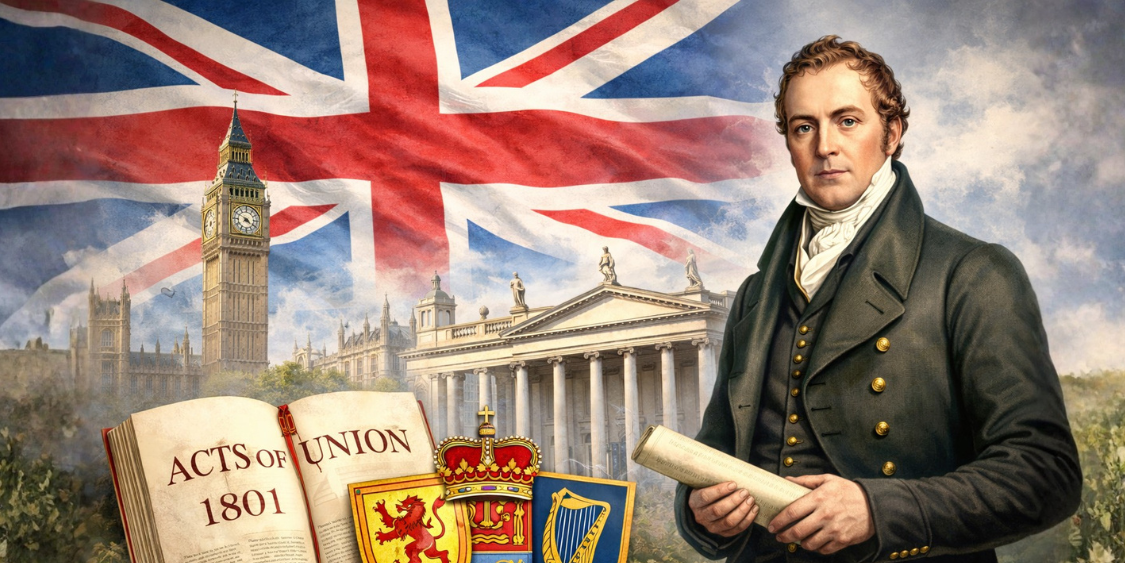
The official name of the UK is the United Kingdom of Great Britain and Northern Ireland. They were united by the Act of Union in 1800. One of its chief promoters was Robert Viscount Castlereagh, Chief Secretary of Ireland, later State Secretary for Foreign Affairs (1812-1822). The Act of Union of 1707 had already established a United Kingdom out of the fusion of Scotland and England. This was the first time that the term ‘united’ had been used for the British Isles. The political model was Holland. When the latter became independent from Spain in 1588 (The Spanish Netherlands) the name adopted was the United Provinces. The leader of the newly founded Republic of the United Provinces was a stadholder, ‘regent’, Maurice, Prince of Orange. The House of Orange provided the leaders for the United Provinces, until William III of Orange became king of England in 1688. Thus, the term United to designate a country originates in the Netherlands.
The British Isles had already been politically connected by a personal union. James VI of Scotland inherited the Kingdom of England from his cousin, Queen Elizabeth. Each Kingdom (England, Scotland, and Ireland) had its own parliament, under the same king James. His person was the main point of political connection. Under him, the royal coat of arms represented the three nations in its quarterings. A personal union was a regular practice in the Middle Ages. A ‘United’ country with a single parliament was the invention of the Netherlands and the House of Orange in 1588. The United Kingdom of 1707 meant that Scotland and England would operate under the same parliament and King. The new situation lasted until 1800 when the Parliament of Great Britain included representatives from Ireland and became the Parliament of the United Kingdom. The flag of this new country was the ‘Union Jack’.
The act of Union of 1800 solved a constitutional headache. The personal union of the king and the United Kingdom were finally aligned. Soon after (treaty of Amiens in 1802) the King formally renounced the title of King of France which English monarchs had held since 1340. The parliamentary Union meant the creation of a single area for trade and a single jurisdiction for taxation. Freedom of circulation of goods within the nations with no internal barriers (customs union). The parliament would also legislate on a single defence system. Ireland would protect Great Britain and vice-versa. New laws were the same for all four nations starting in 1800.
United does not mean unified. The nations which constitute the United Kingdom are not expected to become identical, on the contrary, united implies the collaboration of nations which are different. They are dissimilar, but contribute to common goals: foreign policy, defence, and the overall economy. The Act of Union of 1800 is clear about these aims.
Article 1 The United Kingdom of Great Britain and Ireland
Article 2 Succession of the Monarch
Article 3 One Parliament
Article 4 Members of Parliament
Article 5 United Church of England and Ireland
Article 6 Customs Union
Articles 3 to 6 were aimed to establish the equality of the subjects of the United Kingdom, in matters of representation, worship, and trade.
The Act of Union of 1800 also extended the application of the Bill of Rights (1689) to Ireland. The latter had been proclaimed in England, but at the time had no application in the Kingdom of Ireland. After 1800 its validity was extended to all the British Isles. A key provision was the sovereignty and freedom of the Parliament. Thus 1800 marked the conclusion of a process by which the constituent nations were not only collaborating, given their geographical proximity and shared history, but were now united. The model for a United country was the Netherlands under the stadholder Maurice Prince of Orange. The role of the united parliament was then fixed by William of Orange in the Bill of Rights of 1689 which applied to Ireland as well starting with the Act of Union in 1800. The United Kingdom was thus established to allow for differences, exchanges, and dialogue internally, while maintaining a common front for what concerned rights, economy, and foreign policy in the face of external challenges.
Castlereagh concluded his speech proposing the act of Union on the 5th February 1800 with the idea that ‘united we stand, divided we fall’:
“If this great work shall be effected, and it at any future day the enemies of Great Britain and mankind shall again be let loose upon the social world, I doubt not that Ireland will be in such a situation of unanimity and power, as to bear a conspicuous part with Great Britain in the glorious task of again delivering and restoring the liberties of Europe.”
Dr Frederick Lauritzen sits on Together UK Foundation’s Advisory Board